*** MOVED ***

NOTE: I have merged the contents of this blog with my web-site. I will not be updating this blog any more.

2008-05-08

Dr Dobb's Journal

I have had a subscription of the print edition of Dr Dobb's Journal (DDJ) for a little over six months now. This renewed relationship with my favourite professional magazine has been a mixed experience so far.

I first came across DDJ in the IIT Kanpur Library about 15 years ago. For someone interested in computer programming, it was a fantastic magazine. Along with BYTE (published only on-line after 1998), which was a fantastic magazine for people interested in microcomputers, it became regular reading for me at the library. I used to read new issues as soon as they became available in the library and would try to read as many of the old issues as I could lay my hands on (the library used to have bound volumes of old issues of these magazines dating back several years). The early issues provide a fascinating insight into the evolution of the personal computer.


When I started my career as a software engineer, I tried to subscribe to DDJ myself. At about Rs 3,000, the annual cost of the subscription at the time was a bit too much for me. This situation did not improve for several years after that. I had to console myself by ordering "Dr Dobb's CD Release 6", a CD that contained electronic versions of all the DDJ issues from January 1988 to June 1998.


When I noticed recently that the print issues of DDJ were available internationally at just $30 (about Rs 1,200) a year, I jumped at the opportunity to order a subscription for myself. Even though an electronic edition of an issue is immediately made available to subscribers, I always prefer to read the "dead-tree" (print) edition when possible. I eagerly waited for my copy of the print edition to arrive in my mailbox. I was setting myself up for frustration.


My copy of the November 2007 issue of DDJ arrived two and a half months after it was announced! To top that, the December 2007 issue did not arrive at all. To add insult to injury, my email to them inquiring about this problem was rejected by their "Barracuda Spam Firewall" with a terse message stating that "Message content rejected". As if to then really irritate me, they sent a letter in January 2008 asking me to renew my subscription ten months before it was set to expire!


Fortunately for me, the situation improved considerably from January 2008 and the issues started arriving regularly and well in time (as was the case many years ago, an issue of DDJ arrives about a fortnight before the corresponding month - for example, the issue for May 2008 was delivered in mid-April).


The first thing I noticed about these issues was that they were really thin - they seem to be about one-third the thickness of the old issues of DDJ from what I remember. Could that be the reason for the drop in prices? The second thing I noticed in the initial issues was that many of the articles were about web development and other such things in which I do not have that much interest. Was it going to be like this for the rest of the year?


Once again, fortunately for me, the more recent issues have featured some really nice articles. Articles like "Fast String Search on Multicore Processors" and "Detecting Bugs in Safety-Critical Code", for example, provide insights into areas beyond the realm of run-of-the-mill software development. Herb Sutter's "Effective Concurrency" is a really nice column. The issues for April 2008 (Algorithms) and for May 2008 (Programming Languages) in particular were quintessential DDJ.


Most elements of DDJ have not changed much over the years. The articles still have the same feel to them and most of the advertisements for software products are still embarrassingly corny. The PC-lint Bug of the Month series of advertisements are still there, though they are about C++ instead of C as a reflection of the changing times.


So would I still recommend this magazine to a programmer in India? Yes, definitely. Even with the cost of international shipping included, this magazine costs the same or less than comparable Indian magazines (such as they are) and the quality and the depth of the articles is usually much better.

2008-04-29

A Non-Cellular Organism

Granta is a quarterly high-quality literary magazine that attempts to showcase some of the best "new writing" in English. It has had a decent record in recognising some of the best young novelists before they became famous. It recently published a celebratory 100th issue with contributions from the likes of Martin Amis, Doris Lessing, Salman Rushdie, Ian McEwan, etc. Naturally, I had to have it.

I noticed that Granta 100 was available from Indiaplaza at a good discount, even when the shipping charges were included. In fact, Indiaplaza (formerly Fabmall) seems to be offering a good discount on a lot of books and other items these days. For example, if you buy the entire collection of Asterix comics, you get the entire collection of Tintin comics for free. So I decided to order my copy of Granta 100 from Indiaplaza.


That is when I ran into an unexpected hurdle - the new order form on Indiaplaza requires a mobile phone number and I do not have a mobile phone. The form would not accept a land-line number and even checks for numbers that do not "look like" a mobile phone number. When I complained to their customer service about this issue, they told me that their "delivery partner" requires this information in case they need to contact me. When I then asked them why their delivery partner shies from calling people on their land-line numbers, they relented and themselves suggested that I use a dummy mobile phone number like "98000 00000" to get past the stubborn order form. It worked and I was able to place the order. The item was delivered after a day without further ado.


This is not an isolated incident. I keep running into situations where the other party makes it mandatory for me to divulge my mobile phone number, even though I don't have one and even though they should be able to provide the service without knowing it. For example, HDFC Bank requires it in their form for enabling third-party transfers (in order to notify you of such a transfer when it happens) and Standard Chartered would not allow you to carry out certain transactions on-line without an additional code that they send to your mobile phone (ostensibly for extra security). In each of these cases, the vendor would be able to provide an additional benefit when it has the number for your mobile phone but that does not mean that it should make it mandatory for you to divulge this information.


Even if I did have a mobile phone, I wouldn't want to give its number to all and sundry, especially when they are known to happily hand it over to telemarketers without any respect for their own customers' privacy. Since mobile number portability is still not available in India, it is not a good idea to bind more and more services with your mobile phone should you wish to change your mobile phone service provider in the future.


I do not carry a mobile phone because of its invasive nature. I sometimes get annoyed by people who carry mobile phones for reasons given in this article. I have land-line phones in both my office as well as my home - when I am not in either of these places, I am most likely unable to or unwilling to have a telephonic conversation (for example, while I am driving or while I am watching a film). I do recognise the utility and convenience of having a mobile phone and some day I might also get one, but I do not have one at the moment and I detest it when people make it unnecessarily mandatory for providing a service.

2008-04-06

Stop Taxing the Interest from a Savings Account

It is utterly unfair for the Indian government to impose an income tax on the interest earned by an individual on a savings account. The government merely adds insult to an injury caused by low rates of interest, lower effective yields and high inflation.

2008-03-18

A Dismal Quest

I am looking for a good introductory book on economics to teach myself the basics of this dismal science. From the little I know about it, I have come to realise how important it is in helping one make sense of much that happens in the modern world. I am looking for a book that systematically provides a comprehensive introduction to the principles of macro-economics and micro-economics.

The most popular text for this purpose, till recent times, seems to be "Economics" by Paul Samuelson and William Nordhaus. However, N. Gregory Mankiw's "Principles of Economics" seems to be becoming increasingly popular these days. Fortunately for me, both of these books are available in cheap Indian editions. I flipped through the pages of these books in a bookshop and I must say that Prof. Mankiw's book looks far more approachable to a layman.

I notice that Paul Krugman has also come out with such a book titled "Economics", though I couldn't locate an Indian edition for the book. There are also freely-available economics text-books published on-line like "Introduction to Economic Analysis" by R. Preston McAfee (an "open-source book") and "Principles of Economics" by Timothy Taylor (an advertisement-supported book). I do not like reading lots of text on the computer screen and I cannot order the "dead-tree" versions of these books until I know for sure that they really are better than the more popular alternatives (viz. the books by Prof. Samuelson and Prof. Mankiw).

I would like to ask those of you who are more knowledgeable in economics: what book would you recommend for this purpose?

2008-01-05

A Taste of Haskell

"A Taste of Haskell" was a tutorial given by Simon Peyton Jones during the OSCON 2007 conference. It introduces programmers to the Haskell programming language using the xmonad window manager for X. The complete video of the tutorial is available in two parts (Part 1; Part 2; about 798 MB in total) and lasts for about three hours. The slides for the tutorial are also available (PDF; about 7 MB; 119 slides). The first time I read about this tutorial was in a post on Jao Ortega's blog. I have been meaning to check the video out ever since, but only now have I been able to finish watching it completely.

2007-12-26

Indian Cuisine

The latest issue of The Week has an article titled "The Taste of India" by Vir Sanghvi, where he tries to explain why most foreigners do not appreciate Indian cuisine. Apart from being a famous journalist and a television interviewer here in India, Vir Sanghvi has also been writing about food for some time. He also hosts the show "A Matter of Taste" on Discovery Travel & Living. In this article he argues that what the foreigners normally get to taste is not the real Indian cuisine and that Indian cuisine is far too varied and subtle when compared to other cuisines.

Many of us realise that Indian cuisine is not considered in the same league as, say, French or Italian cuisine by most foreigners.
All Indian dishes look the same, a sort of brown mess; the level of spices is so high that you can never taste the flavour of the original ingredients; the cuisine has not evolved over the decades unlike French food; and Indians have no understanding of texture.


Why does our food invite this epicurean derision? More importantly, have these foreigners had a chance to taste the real Indian cuisine?
First of all, most of the so-called 'experts' who are sniffy about Indian food haven't actually eaten it in India. They rely on British-Indian cuisine, a bastard school of cooking invented by Bangladeshis tinkering around with the Punjabi menu. Secondly, even those who have eaten in India have never experienced the diversity of our nation's cuisine. Foreign foodies like countries such as Thailand where they can tour the length and breadth of the whole nation in one week and declare themselves 'experts' on Thai cuisine.
[...]
Foreigners rarely recognise this unique characteristic of Indian cuisine because they either eat their meals in Indian restaurants abroad or stick to hotel restaurants where chefs faithfully reproduce the standard recipes they were taught at catering college.
[...]
That is a tough one because when most people talk about great cuisines they talk about restaurant food. And, let's face it; there aren't many great Indian restaurants. If you want amazing south Indian food, you need to go to people's homes. If you want good Lucknawi cuisine your best bet is still one of the wedding caterers from an old Muslim family. Rarely, if ever, will you get food of that calibre at restaurants.


This is something that I have noticed as well. The food that you get in the restaurants, even here in India, rarely comes close to what people actually prepare in their homes. Restaurants in five-star hotels are particularly pathetic in that they serve utterly bland dishes for exorbitant prices and call it Indian cuisine. On the few occasions that I have travelled abroad and eaten in an "Indian" restaurant, the dishes didn't even come close to what we Indians would recognise as our cuisine. I am told that the same problem plagues the Chinese cuisine - what we get in "Chinese" restaurants, especially here in India, is far from what the Chinese actually eat in their homes. You really must eat in an Indian's home to get a feel for Indian food.

There are also some nice titbits about the evolution of Indian cuisine in the article.
But if we are talking about adaptability, then consider this: until the European colonists got to India, we had never heard of the chilli and had never seen a potato. Can anybody imagine modern Indian cuisine without these ingredients?
[...]
The tandoori chicken is now the world's most famous Indian dish. But how many people recognise that tandoori chicken, its cousin the chicken tikka and their ill-begotten offspring the butter chicken, were all invented in the 1940s and sprang to fame only in the 1950s and 1960s. If that is not culinary evolution, then what is?

2007-12-22

IIT Kanpur

I had a chance recently to visit my alma mater IIT Kanpur. It has been over 11 years since I graduated from that place. This is the first time in all these years that I got to visit the place, though I had been yearning to do so all the while. It turned out to be a mixed experience - I found IIT Kanpur to be familiar and estranging at the same time.

2007-12-04

The Golden Compass

Some days back, I saw the trailer for the film "The Golden Compass". I am eagerly looking forward to watching this film, as it is based on the eponymous book that is the first in the fantastic "His Dark Materials" trilogy by Philip Pullman.

"His Dark Materials" sadly does not seem to have achieved as much popularity as some of the other less-deserving sagas. I for one didn't even know that such a series existed until Ananth had pointed it out to me and given me his copies of the books to read. Once I had read it though, I liked it immensely (my review of the series on Amazon.com; the same on my web-site). I some times even use the names "Lyra" and "Pantalaimon" in my code and scripts instead of the prosaic "foo" and "bar", much to the bewilderment of the reviewers.

Ananth is so excited about watching the film and its sequels that he has already re-read the books to refresh his memory. He plans to watch the first show of the first day for the film. He eagerly laps up articles about Dakota Blue Richards, the young girl who will play the role of "Lyra", the charming protagonist of the books.

I always have a mixture of excitement and dread when I learn of a film based on a book that I have liked - for me, the Lord of the Rings trilogy of films are the only such films that haven't left me disappointed. When you read a book, you imagine the characters and the scenes in a certain way that might not be shared by the director of a film. A film is also constrained by a limit on the duration of the film, which might not be enough to develop all the characters to the extent the book has done. When those who have not read the book watch the film, they usually either get confused or miss a lot of (what you consider) important references in the dialogues. You still look forward to watching the films because you want to see how the directors have realised the books as films, because you want to revisit the characters and the story and because you hope that the films will get more people interested in reading the respective books.

I will keep my fingers and my toes crossed.

2007-11-15

New Delhi

In a quirk of modern air-travel, it is usually cheaper to travel from Bhopal to Bangalore via New Delhi, which is about 750 kilometres in the opposite direction, than via Mumbai which would appear to be a much shorter route. This time Anusha and I decided to use the opportunity thus afforded to stay over in New Delhi for a little over a day and see some of the main tourist attractions.

As I have noted before, to someone coming from a place like Bangalore where traffic is always slowed down by congestion and potholes, the fast traffic on the smooth and wide roads of New Delhi comes as a bit of a shock. Taxi drivers drive even faster than the other folks, not bothering to slow down for junctions or turns. Everyone snakes in and out of traffic lanes with abandon and freely exchanges expletives at the slightest provocation.

Despite the presence of so much traffic, the air-pollution seems to be manageable, no doubt helped by the mandatory installation of Compressed Natural Gas (CNG) systems in public vehicles. New Delhi also has a lot of green trees, quite unlike that jungle of concrete, Mumbai. One of the more surprising sights for me in New Delhi was the row of toll booths at the entry to the DND Flyway, something that you rarely see in a developing country like India.


Among the standard tourist attractions, some of the places were either only mildly interesting or particularly underwhelming. However, I was particularly fascinated by Humayun's Tomb, the Qutub Minar complex and the Red Fort.

I had not expected Humayun's Tomb to be such a big, peaceful and beautiful complex. It was restored and beautified only as recently as 2003. The main mausoleum is particularly remarkable since it looks so similar to the Taj Mahal, although it was constructed almost 100 years before the latter. Some of the other buildings in the complex are also nice, although many of the places reek very strongly of bat droppings.


Even the Qutub Minar surprised me with its height and beauty. It has beautiful carvings on its walls and a nice pattern to the first three storeys. Sadly however, the last two storeys, which were later additions, are quite discordant with the rest of the tower. While the Qutub Minar is quite impressive by itself, one can only imagine the magnificence of the entire complex in its prime by looking at its sad remains. Some of the walls still retain bits of intricate carvings.


The Red Fort was built by the Mughal emperor Shah Jahan as a palace for his eponymous new capital Shahjahanabad. It is a splendid structure and seems fairly well-preserved. Of particular note are the royal residence, the "deewan-e-aam" (where the emperor met the common people), the "deewan-e-khaas" (where the emperor met his ministers and important guests) and the museum housing some interesting artefacts of that era. The "deewan-e-khaas", the emperor's seat in the "deewan-e-aam" and the royal residence are lavishly decorated and are a must-see.


I have created a Picasa web-album that has some more pictures from New Delhi.

2007-11-13

Pachmarhi

On a recent trip to Bhopal, Anusha and I visited Pachmarhi. Pachmarhi is a little-known, but very beautiful, hill-station in Madhya Pradesh that deserves to be more popular. It is the highest town on the Satpura range of hills, situated about 900 metres (3,000 feet) above the sea-level. It is surrounded by the Satpura National Park.

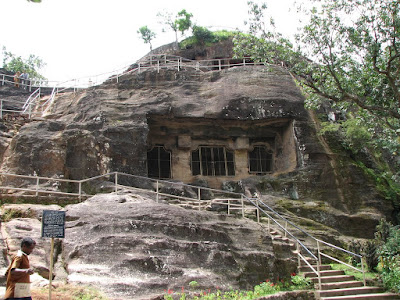
Pachmarhi gets its name from a set of five caves carved into a big rock. These caves are called Pandava Caves because it was believed that the Pandavas stayed here for some time during their exile from their kingdom. However, it turns out that these caves were really carved out by Buddhist monks who used them as shelters.


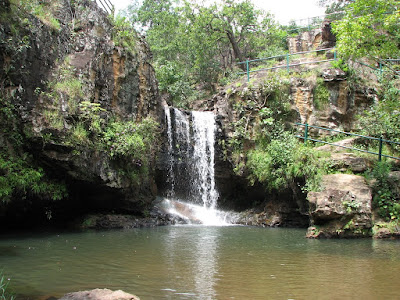
Most of the rocks in Pachmarhi are made of soft sandstone. These rocks soak up water during the rains and then slowly release it throughout the rest of the year. This water feeds the many streams that flow through Pachmarhi and provide its beautiful waterfalls. A remarkable thing about these rocks is that some of them clearly show layers of embedded round pebbles. Though it is at a high altitude now, Pachmarhi must have been under water a long time ago.


We decided to stay in Glen View, a hotel developed by Madhya Pradesh Tourism. We also took their bus from Bhopal to reach Pachmarhi. The bus usually takes around five hours for the journey. As luck would have it, we ran into a chakka jam (road blockade) organised by the BJP that day to protest against the Sethusamudram project. This delayed us by three hours.

Pachmarhi is a very small town, most of which is occupied by the Indian army. It has a very unhurried and quiet feel to it. The local people are very friendly and helpful. It is surrounded by stunningly beautiful forests, valleys, waterfalls and caves. There are several trekking trails for enthusiasts. Some of the caves have pre-historic rock paintings. It also has several Shiva temples, each one associated with a myth relating to his fight against Bhashmasura. There are so many places to see that it can easily take about five days to explore everything properly.


It is not easy reaching these beautiful spots though. You have to have a car with a four-wheel drive and an expert driver to drive it. You should also have a bit of stamina because the car would not be able to take you all the way everywhere and you would have to go about 200 to 400 metres up and down a hill to reach many a spot.

I had an especially tough time reaching these spots because I found it hard to breathe. That was because I had a very bad cold. That in turn was because the air-conditioner in our room could only be run at its full strength. The ceiling fan was not enough for the hot and humid weather at the time. This was one of the worst colds I have ever suffered. It took a full two weeks for me to recover completely from it.

This was not the only problem with our room though. The water from the taps was always reddish-brown from the rust in the pipes for a while in the beginning and you had to leave it on for some time for it to approach something close to transparency. Even then it had an unpleasant iron flavour to it. The hotel staff was extremely nonchalant about it, informing us that it was quite normal for all the rooms in the hotel.

Pachmarhi does not have good options for accommodation at this time. None of the well-known hotel chains have their presence here, so you tend to err on the side of caution by opting for what is touted as a luxury hotel. Glen View is promoted as a luxury hotel by MP Tourism. Judging by our experience, they seem to have a rather peculiar definition of "luxury". To add insult to injury, they insist on collecting 100% of the hotel tariff for all the days you plan to stay there, in advance at the time of booking, with no scope for refunds. The hotel also does not accept credit cards, so you better carry some good cash to pay for the ridiculous amount it charges for its unremarkable food.

We were so disappointed by our hotel and the lack of other options that we cut our visit short by a day, losing some money in the process. We took some solace in the fact that we had saved almost 30% by booking it during the off-season. We would love to go back and see Pachmarhi again and explore the sites we could not visit, but not until there are better options for accommodation there.

I have created a Picasa web-album that has some more pictures from Pachmarhi.