*** MOVED ***

NOTE: I have merged the contents of this blog with my web-site. I will not be updating this blog any more.

2007-12-26

Indian Cuisine

The latest issue of The Week has an article titled "The Taste of India" by Vir Sanghvi, where he tries to explain why most foreigners do not appreciate Indian cuisine. Apart from being a famous journalist and a television interviewer here in India, Vir Sanghvi has also been writing about food for some time. He also hosts the show "A Matter of Taste" on Discovery Travel & Living. In this article he argues that what the foreigners normally get to taste is not the real Indian cuisine and that Indian cuisine is far too varied and subtle when compared to other cuisines.

Many of us realise that Indian cuisine is not considered in the same league as, say, French or Italian cuisine by most foreigners.
All Indian dishes look the same, a sort of brown mess; the level of spices is so high that you can never taste the flavour of the original ingredients; the cuisine has not evolved over the decades unlike French food; and Indians have no understanding of texture.


Why does our food invite this epicurean derision? More importantly, have these foreigners had a chance to taste the real Indian cuisine?
First of all, most of the so-called 'experts' who are sniffy about Indian food haven't actually eaten it in India. They rely on British-Indian cuisine, a bastard school of cooking invented by Bangladeshis tinkering around with the Punjabi menu. Secondly, even those who have eaten in India have never experienced the diversity of our nation's cuisine. Foreign foodies like countries such as Thailand where they can tour the length and breadth of the whole nation in one week and declare themselves 'experts' on Thai cuisine.
[...]
Foreigners rarely recognise this unique characteristic of Indian cuisine because they either eat their meals in Indian restaurants abroad or stick to hotel restaurants where chefs faithfully reproduce the standard recipes they were taught at catering college.
[...]
That is a tough one because when most people talk about great cuisines they talk about restaurant food. And, let's face it; there aren't many great Indian restaurants. If you want amazing south Indian food, you need to go to people's homes. If you want good Lucknawi cuisine your best bet is still one of the wedding caterers from an old Muslim family. Rarely, if ever, will you get food of that calibre at restaurants.


This is something that I have noticed as well. The food that you get in the restaurants, even here in India, rarely comes close to what people actually prepare in their homes. Restaurants in five-star hotels are particularly pathetic in that they serve utterly bland dishes for exorbitant prices and call it Indian cuisine. On the few occasions that I have travelled abroad and eaten in an "Indian" restaurant, the dishes didn't even come close to what we Indians would recognise as our cuisine. I am told that the same problem plagues the Chinese cuisine - what we get in "Chinese" restaurants, especially here in India, is far from what the Chinese actually eat in their homes. You really must eat in an Indian's home to get a feel for Indian food.

There are also some nice titbits about the evolution of Indian cuisine in the article.
But if we are talking about adaptability, then consider this: until the European colonists got to India, we had never heard of the chilli and had never seen a potato. Can anybody imagine modern Indian cuisine without these ingredients?
[...]
The tandoori chicken is now the world's most famous Indian dish. But how many people recognise that tandoori chicken, its cousin the chicken tikka and their ill-begotten offspring the butter chicken, were all invented in the 1940s and sprang to fame only in the 1950s and 1960s. If that is not culinary evolution, then what is?

2007-12-22

IIT Kanpur

I had a chance recently to visit my alma mater IIT Kanpur. It has been over 11 years since I graduated from that place. This is the first time in all these years that I got to visit the place, though I had been yearning to do so all the while. It turned out to be a mixed experience - I found IIT Kanpur to be familiar and estranging at the same time.

2007-12-04

The Golden Compass

Some days back, I saw the trailer for the film "The Golden Compass". I am eagerly looking forward to watching this film, as it is based on the eponymous book that is the first in the fantastic "His Dark Materials" trilogy by Philip Pullman.

"His Dark Materials" sadly does not seem to have achieved as much popularity as some of the other less-deserving sagas. I for one didn't even know that such a series existed until Ananth had pointed it out to me and given me his copies of the books to read. Once I had read it though, I liked it immensely (my review of the series on Amazon.com; the same on my web-site). I some times even use the names "Lyra" and "Pantalaimon" in my code and scripts instead of the prosaic "foo" and "bar", much to the bewilderment of the reviewers.

Ananth is so excited about watching the film and its sequels that he has already re-read the books to refresh his memory. He plans to watch the first show of the first day for the film. He eagerly laps up articles about Dakota Blue Richards, the young girl who will play the role of "Lyra", the charming protagonist of the books.

I always have a mixture of excitement and dread when I learn of a film based on a book that I have liked - for me, the Lord of the Rings trilogy of films are the only such films that haven't left me disappointed. When you read a book, you imagine the characters and the scenes in a certain way that might not be shared by the director of a film. A film is also constrained by a limit on the duration of the film, which might not be enough to develop all the characters to the extent the book has done. When those who have not read the book watch the film, they usually either get confused or miss a lot of (what you consider) important references in the dialogues. You still look forward to watching the films because you want to see how the directors have realised the books as films, because you want to revisit the characters and the story and because you hope that the films will get more people interested in reading the respective books.

I will keep my fingers and my toes crossed.

2007-11-15

New Delhi

In a quirk of modern air-travel, it is usually cheaper to travel from Bhopal to Bangalore via New Delhi, which is about 750 kilometres in the opposite direction, than via Mumbai which would appear to be a much shorter route. This time Anusha and I decided to use the opportunity thus afforded to stay over in New Delhi for a little over a day and see some of the main tourist attractions.

As I have noted before, to someone coming from a place like Bangalore where traffic is always slowed down by congestion and potholes, the fast traffic on the smooth and wide roads of New Delhi comes as a bit of a shock. Taxi drivers drive even faster than the other folks, not bothering to slow down for junctions or turns. Everyone snakes in and out of traffic lanes with abandon and freely exchanges expletives at the slightest provocation.

Despite the presence of so much traffic, the air-pollution seems to be manageable, no doubt helped by the mandatory installation of Compressed Natural Gas (CNG) systems in public vehicles. New Delhi also has a lot of green trees, quite unlike that jungle of concrete, Mumbai. One of the more surprising sights for me in New Delhi was the row of toll booths at the entry to the DND Flyway, something that you rarely see in a developing country like India.


Among the standard tourist attractions, some of the places were either only mildly interesting or particularly underwhelming. However, I was particularly fascinated by Humayun's Tomb, the Qutub Minar complex and the Red Fort.

I had not expected Humayun's Tomb to be such a big, peaceful and beautiful complex. It was restored and beautified only as recently as 2003. The main mausoleum is particularly remarkable since it looks so similar to the Taj Mahal, although it was constructed almost 100 years before the latter. Some of the other buildings in the complex are also nice, although many of the places reek very strongly of bat droppings.


Even the Qutub Minar surprised me with its height and beauty. It has beautiful carvings on its walls and a nice pattern to the first three storeys. Sadly however, the last two storeys, which were later additions, are quite discordant with the rest of the tower. While the Qutub Minar is quite impressive by itself, one can only imagine the magnificence of the entire complex in its prime by looking at its sad remains. Some of the walls still retain bits of intricate carvings.


The Red Fort was built by the Mughal emperor Shah Jahan as a palace for his eponymous new capital Shahjahanabad. It is a splendid structure and seems fairly well-preserved. Of particular note are the royal residence, the "deewan-e-aam" (where the emperor met the common people), the "deewan-e-khaas" (where the emperor met his ministers and important guests) and the museum housing some interesting artefacts of that era. The "deewan-e-khaas", the emperor's seat in the "deewan-e-aam" and the royal residence are lavishly decorated and are a must-see.


I have created a Picasa web-album that has some more pictures from New Delhi.

2007-11-13

Pachmarhi

On a recent trip to Bhopal, Anusha and I visited Pachmarhi. Pachmarhi is a little-known, but very beautiful, hill-station in Madhya Pradesh that deserves to be more popular. It is the highest town on the Satpura range of hills, situated about 900 metres (3,000 feet) above the sea-level. It is surrounded by the Satpura National Park.

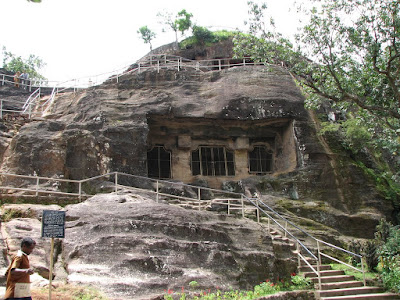
Pachmarhi gets its name from a set of five caves carved into a big rock. These caves are called Pandava Caves because it was believed that the Pandavas stayed here for some time during their exile from their kingdom. However, it turns out that these caves were really carved out by Buddhist monks who used them as shelters.


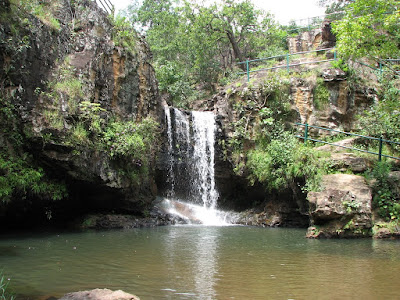
Most of the rocks in Pachmarhi are made of soft sandstone. These rocks soak up water during the rains and then slowly release it throughout the rest of the year. This water feeds the many streams that flow through Pachmarhi and provide its beautiful waterfalls. A remarkable thing about these rocks is that some of them clearly show layers of embedded round pebbles. Though it is at a high altitude now, Pachmarhi must have been under water a long time ago.


We decided to stay in Glen View, a hotel developed by Madhya Pradesh Tourism. We also took their bus from Bhopal to reach Pachmarhi. The bus usually takes around five hours for the journey. As luck would have it, we ran into a chakka jam (road blockade) organised by the BJP that day to protest against the Sethusamudram project. This delayed us by three hours.

Pachmarhi is a very small town, most of which is occupied by the Indian army. It has a very unhurried and quiet feel to it. The local people are very friendly and helpful. It is surrounded by stunningly beautiful forests, valleys, waterfalls and caves. There are several trekking trails for enthusiasts. Some of the caves have pre-historic rock paintings. It also has several Shiva temples, each one associated with a myth relating to his fight against Bhashmasura. There are so many places to see that it can easily take about five days to explore everything properly.


It is not easy reaching these beautiful spots though. You have to have a car with a four-wheel drive and an expert driver to drive it. You should also have a bit of stamina because the car would not be able to take you all the way everywhere and you would have to go about 200 to 400 metres up and down a hill to reach many a spot.

I had an especially tough time reaching these spots because I found it hard to breathe. That was because I had a very bad cold. That in turn was because the air-conditioner in our room could only be run at its full strength. The ceiling fan was not enough for the hot and humid weather at the time. This was one of the worst colds I have ever suffered. It took a full two weeks for me to recover completely from it.

This was not the only problem with our room though. The water from the taps was always reddish-brown from the rust in the pipes for a while in the beginning and you had to leave it on for some time for it to approach something close to transparency. Even then it had an unpleasant iron flavour to it. The hotel staff was extremely nonchalant about it, informing us that it was quite normal for all the rooms in the hotel.

Pachmarhi does not have good options for accommodation at this time. None of the well-known hotel chains have their presence here, so you tend to err on the side of caution by opting for what is touted as a luxury hotel. Glen View is promoted as a luxury hotel by MP Tourism. Judging by our experience, they seem to have a rather peculiar definition of "luxury". To add insult to injury, they insist on collecting 100% of the hotel tariff for all the days you plan to stay there, in advance at the time of booking, with no scope for refunds. The hotel also does not accept credit cards, so you better carry some good cash to pay for the ridiculous amount it charges for its unremarkable food.

We were so disappointed by our hotel and the lack of other options that we cut our visit short by a day, losing some money in the process. We took some solace in the fact that we had saved almost 30% by booking it during the off-season. We would love to go back and see Pachmarhi again and explore the sites we could not visit, but not until there are better options for accommodation there.

I have created a Picasa web-album that has some more pictures from Pachmarhi.

2007-10-19

Lossy Marvels

JPEG and MP3 are very popular formats for storing photographs and music respectively. They are both lossy formats and yet achieve amazing compression ratios without a loss of quality that is easily perceptible by normal people. I have always wondered how this is achieved.

The respective technical specifications are unfortunately too complicated to follow for a layman. Purportedly "explanatory" articles elsewhere gloss too much over the important points leaving me quite unsatisfied. I have fortunately come across two articles recently that seem to strike the perfect balance between these extremes.

"The Audiofile: Understanding MP3 Compression" was published in Ars Technica some time back and very nicely explains the compression algorithm behind MP3 as well as shedding some light over some of the apparent idiosyncrasies of this format. "Image Compression: Seeing What's Not There" was published by the American Mathematical Society and does a similar service for JPEG, including its successor JPEG 2000. (Come to think of it, these articles are "lossy" marvels in their own right.)

Now let us see if I can find an article with a similar depth that explains the MPEG video formats.

2007-10-16

Alex

The Economist carried an obituary for Alex some time back. Alex was an African Grey parrot that Irene Pepperberg had trained to actually understand what it was talking about, unlike the parrots raised as pets which merely repeat whatever they hear.

For a parrot, Alex had impressive linguistic capabilities. It could describe objects, materials, shapes, colours, etc. It could express its desires. It could also ask questions. It could also count up to six and even had a notion of "zero". Very impressive.

2007-10-11

ICFPC 2007: Epilogue

The results of ICFPC 2007 have finally been announced. Team Smartass from Google has come first (yet again), followed by United Coding Team from the University of Cape Town (South Africa) in the second place and Celestial Dire Badger (a lone hacker named Jed Davis) in the third place.

The organisers of the contest have an interesting report on the contest that also contains the "ideal" way one would go about solving the puzzles. Interestingly, Jochen Hoenicke managed to find a perfect DNA prefix some time after the contest was over. Impressively, Jed Davis came third by using a brute-force approach that won him the Judges' Prize - he was declared to be "an extremely cool hacker".

Update (2007-10-24): The organisers have now shared the video of their presentation about the contest at ICFP 2007.

2007-10-03

Product Reviews by "Wayne Redhart"

Kingshuk pointed out the amusing reviews of products posted by a "Wayne Redhart" to the website of Amazon UK.

For some of the products reviewed by him, I found the product on offer more amusing than the review itself.

2007-08-21

Tools for Indians by Google Labs India

The Google Labs India folks have just announced a couple of cool new tools for Indians. This includes being able to search in a number of Indian languages as well as a transliteration tool for easily typing in Devanagari using an ordinary keyboard.

The transliteration tool is especially nice. For example, it automatically converts "ramesh" to "रमेश". If you did not want the word automatically put in by the tool, you can select the desired word from a set of alternatives or explicitly type it out yourself.

Note that you might have to tweak things a little to correctly display Indic scripts.

Update (2007-08-23): QuillPad seems to have been in existence for some time now and has support for more Indian languages than the Google transliteration tool (which only supports Hindi at the moment).

Update (2007-08-29): Raftaar also allows you to search in Hindi using a transliterating interface.